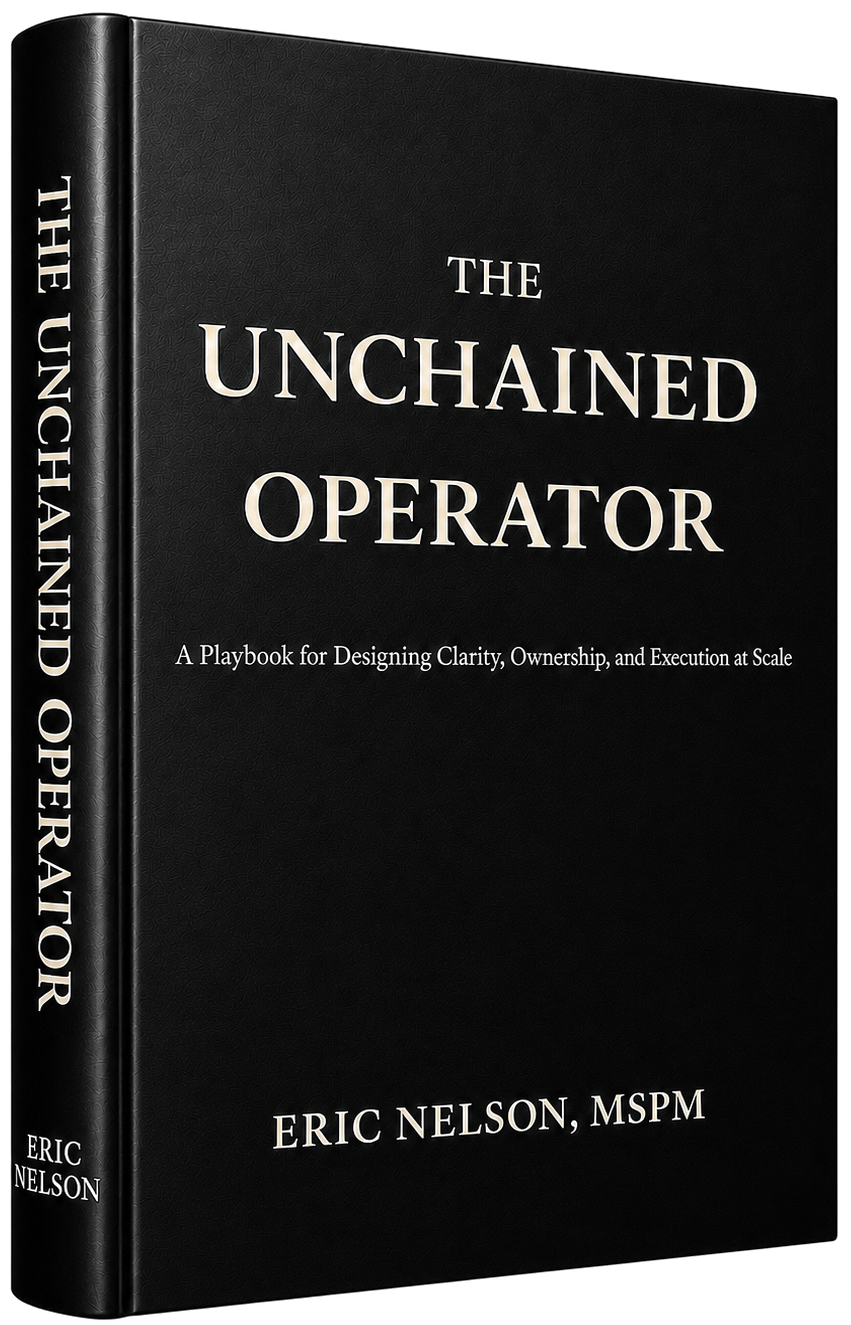
Execution Is Broken
This Book Shows You How to Fix It.
A playbook for designing clarity, ownership, and execution at scale.

Most organizations don’t fail because of bad strategy.
They fail because no one is actually operating the system.
Work keeps moving.
Meetings multiply.
Dashboards get built.
And somehow… execution slows down.
Not because people aren’t trying.
But because the system itself isn’t being operated.
That’s the gap this book is built to close.
What this book actually gives you
This is not a book about project management.
It’s a system for operating execution.
Inside you’ll learn how to operate execution:
Turn strategy into executable structure
Design ownership so decisions don’t stall
Identify and remove friction before it compounds
Build systems that sustain execution at scale
This isn’t theory.
It’s a practical operating model for making execution actually work.
The Operator System
Execution doesn’t fail randomly.
It fails in patterns.
The operator system is built to diagnose, structure, and control execution.
It is designed for environments where execution cannot fail.
Inside the book, you’ll work through a set of integrated frameworks:
Operator Planning Cycle (OPC)
Execution Operating System
Friction Index
Operator Systems Pyramid
Accountability Grid
These are not concepts.
They are tools.
How the system works
Execution isn’t managed.
It’s operated.
Execution fails in stages.
So it must be designed in stages.
Every initiative moves through a defined planning cycle:
Frame the problem clearly
Define constraints and assumptions
Design the execution approach
War-game friction
Finalize and brief
Planning does not create results.
It creates clarity.
Execution begins the moment the plan meets reality.
Each step has a clear owner.
If ownership is unclear, execution will degrade.
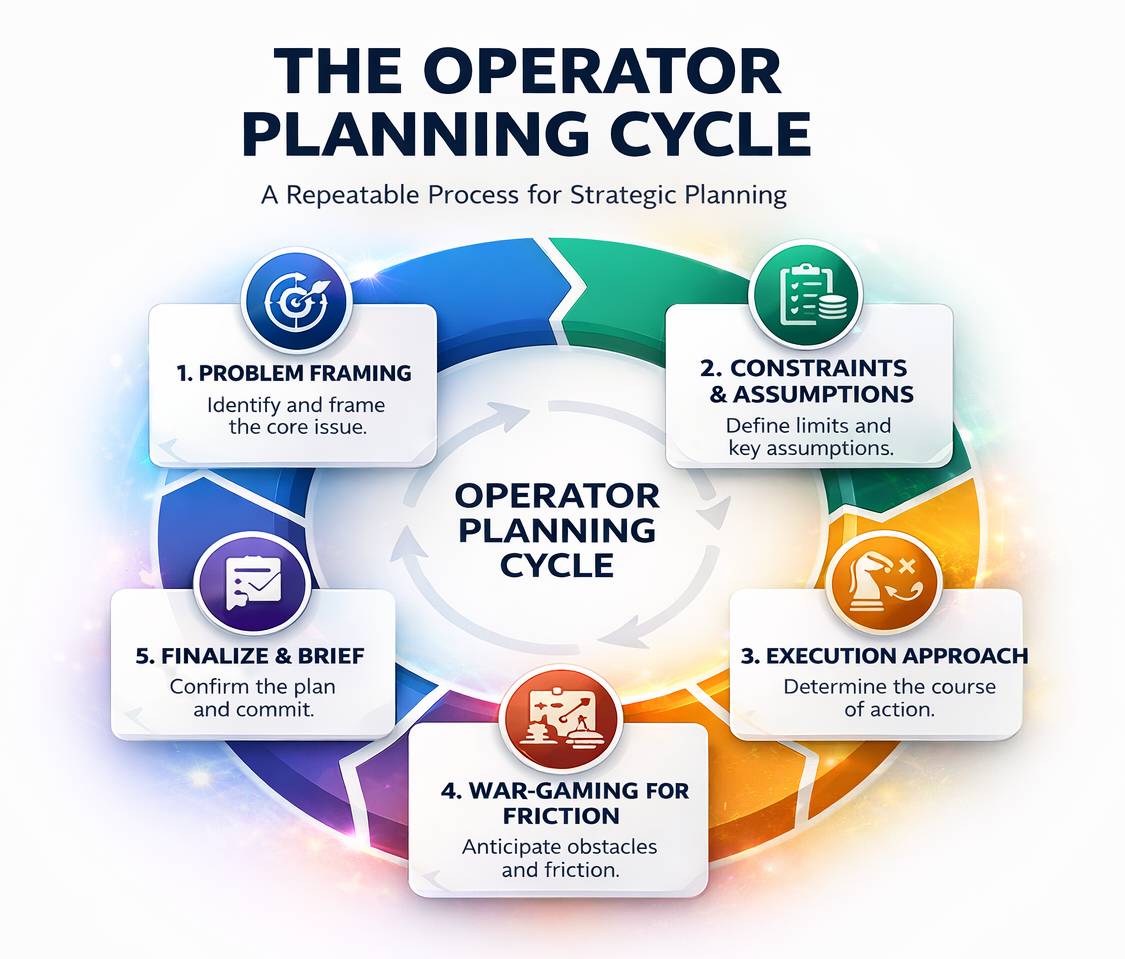
The Operator Planning Cycle is not execution.
It makes execution possible.
Once the plan is finalized, the system shifts to operation.
Most organizations skip this cycle entirely.
They move straight into execution with an untested plan.
And then wonder why it breaks.
This is where the operator takes over.
The Execution Operating System
Execution doesn’t fail because people don’t know what to do.
It fails because there is no system controlling how work moves.
Execution needs structure
It needs rhythm
It needs control.
Every initiative runs inside an operating system.
Not a tool.
Not a dashboard.
A system.
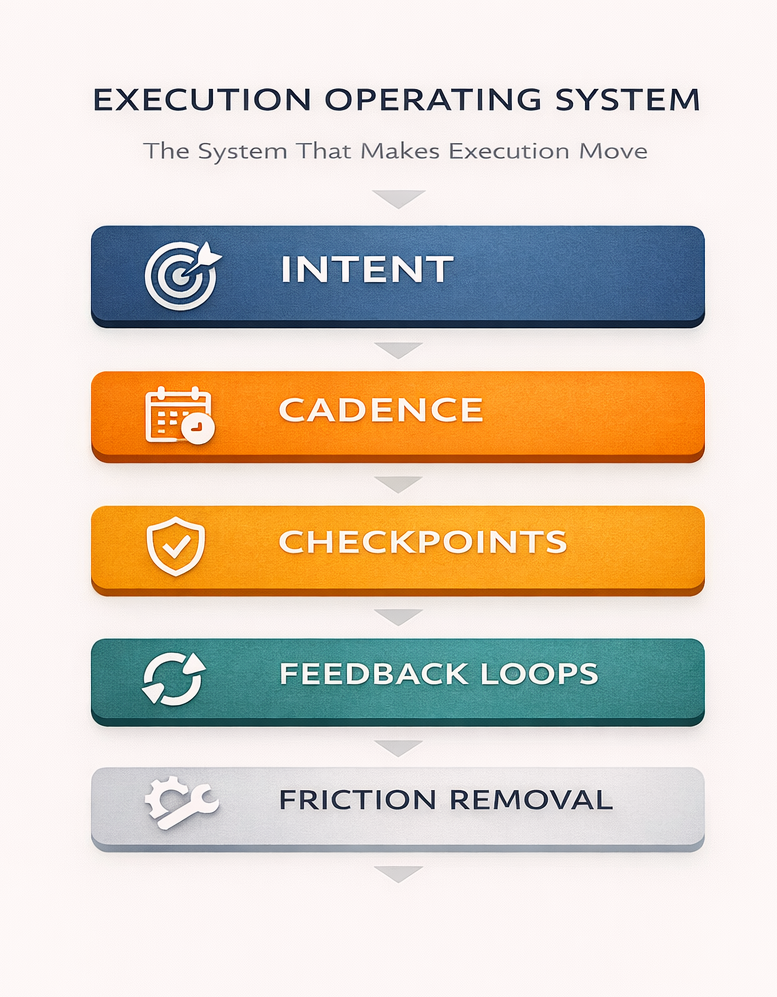
The Execution Operating System is built on five components:
Intent
What must be achieved
Clear. Non-negotiable. Understood by everyone
Cadence
How often the system runs
Daily. Weekly. Monthly
Execution moves at the speed of its rhythm
Checkpoints
Where work is evaluated
Progress is verified
Decisions are made
Feedback Loops
How information flows back into the system
What’s working
What’s not
What needs to change
Friction Removal
How obstacles are identified and eliminated
Before they slow execution down
This system does one thing:
It keeps execution moving.
Without it:
Work becomes reactive
Ownership becomes unclear
Problems compound silently
With it:
Execution becomes controlled
Decisions become faster
Results become predictable
Execution is not a one-time event.
It is a system that must be continuously operated.
This is where most organizations break.
They build plans.
But they never build the system to run them.
This is where the operator takes over.
The Operator Mindset Shift
Execution doesn’t improve with more effort.
It Improves with control.
Most people don’t struggle because they lack intelligence or capability.
They struggle because they’re reacting to a system they don’t control.
Work gets assigned.
Meetings get scheduled.
Priorities shift.
And they adjust to it.
Over time, they become part of the system instead of operating it.
Operators move differently.
They don’t wait for clarity.
They create it.
They don’t accept ownership gaps.
They close them.
They don’t manage tasks.
They control how work flows.
This requires a real shift.
From reacting → to structuring.
From participating → to owning.
From managing work → to operating the system.
Not everyone wants this.
Because once you see the system clearly…
You can’t ignore it.
You either operate it.
Or you accept the consequences of not doing so.
If You’re Responsible for Making Things Work
The ones in the middle of complexity.
Accountable for outcomes.
Without the luxury of waiting for clarity.
If that’s you, this will feel familiar.
Because you’ve already seen the problems.
This gives you a way to take control of execution.
Where to Go Next